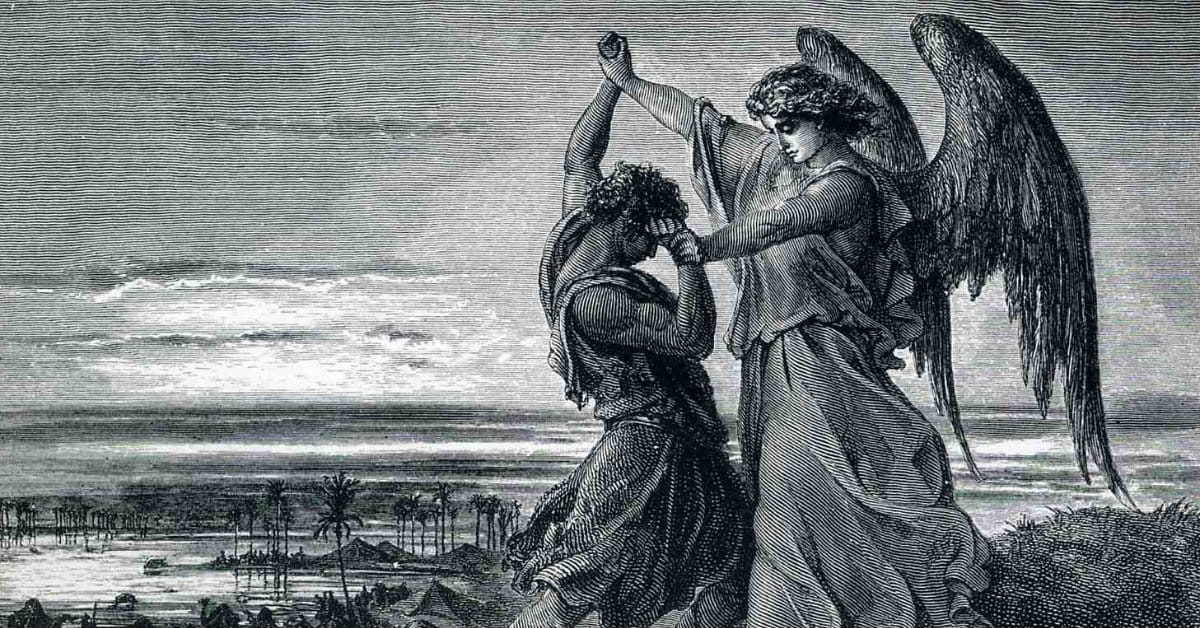
“During the night, Jacob arose, took his two wives, his two maidservants, and his eleven sons, and crossed the ford of the Jabbok. He sent them across the stream, along with all his possessions. Jacob was left alone, and a man wrestled with him until daybreak. When the man saw that he could not overpower him, he touched the socket of Jacob’s hip so that his hip was wrenched as he wrestled with the man. Then the man said, “Let me go, for it is daybreak.” But Jacob replied, “I will not let you go unless you bless me.” The man asked him, “What is your name?” “Jacob,” he answered. Then the man said, “Your name will no longer be Jacob, but Israel, because you have struggled with God and with humans and have overcome.”
For a long time, my understanding of the spiritual path has been shaped by authors such as Eckhart Tolle, Byron Katie, Michael Tamura, Yehuda Berg, Scott Kiloby, and Richard Rudd. Over time, I came to see why their messages about dealing with inevitable suffering resemble each other so closely: only through an inner attitude of acceptance—presence, neutrality, surrender, refraining from reaction, allowing, non-resistance to pain—can we initiate the processes of inner integration. This attitude is, in fact, the only path through which the painful half of life can be integrated into matter.
There is, however, one seemingly small detail that carries enormous importance: acceptance does not arise through a conscious effort to accept. Quite the opposite—it emerges as a by-product of a long process of resistance and struggle, whose energy gradually accumulates, reaches a climax, and—by the principle of enantiodromia—leads to the long-awaited spiritual surrender, the very essence of which is acceptance itself.
But before acceptance comes the struggle—and what an epic struggle it is!
Before reaching enlightenment, Eckhart Tolle had spent many years battling suicidal depression. His awakening came at a moment when he told himself he could no longer bear it—he could no longer stand himself. Then came the thought that unlocked the door to transformation: “If I am the one who hates myself, then there must be two of us. So which one is the real me?” The shock of that question left him speechless. Then another voice arose within him, telling him not to worry, to simply relax. He fell into a black void—and when he woke up the next morning, he realized that everything was love.
After this experience, and after dedicating years to understanding what had happened to him, Eckhart Tolle became a world-renowned spiritual teacher and a source of inspiration for millions. The core message of his teaching is the attitude of presence and non-identification with the painful experiences stored in the collective layers of our shared soul, which he refers to as the “dense pain-body.” I deeply resonate with this message because it is alchemical in nature: it uses suffering for its true purpose—to dissolve the identifications of the empirical self and its attachments to the material world. And most of all, to transform suffering into consciousness.
But what is truly significant here is that he did not reach enlightenment through the attitude of presence and non-identification with pain—but rather through its opposite: through long-standing resistance to his deep inner misery, and fierce self-hatred. And this lasted for years.
The same is true of Byron Katie, author of Loving What Is. She, too, came to the experience of total acceptance of reality—but only after passing through a state of total non-acceptance. In the psychiatric hospital where her transformative awakening took place, she had reached the depths of self-rejection. She felt utterly guilty, entirely unworthy.
These are two examples of spiritual teachers who reached the pinnacle of experience that every seeker dreams of—enlightenment—not by practicing what they would later preach, but through long years of agony, self-hatred, and inner warfare against the destructive forces rising from within. I know how brutally difficult the encounter with collective pain can be, and I deeply honor their immense spiritual strength—for having endured the pressure of those forces and not succumbing to the impulse to end their lives.
At this very moment, someone in the world takes their own life every thirty seconds. And when I refer to the biblical story of Jacob wrestling the angel, I have precisely these kinds of battles in mind.
This is why I feel the need to offer an important clarification: the integration of the destructive part within us does not happen through a simple attitude of acceptance. Presence within the dense pain-body is not a passive meditative act of contemplation—it is a tremendous inner effort not to let negative emotion take hold of your thoughts and actions. At its core, it is a battle—not a relaxation.
The attitude of non-identification with one’s experience is, in essence, an act of resistance.
It is the effort not to succumb to what you’re experiencing, not to give it access to your mind or your will. And just as radical doubt is the gateway to true faith, so too is the capacity for resistance the precondition for true acceptance. It is precisely the ability to endure to the end, without surrender, that becomes the necessary ground for genuine spiritual surrender—the kind of surrender taught by spiritual teachers.
And here comes the deeper mystery: it has to do with the soul’s ability to hold the opposites within itself. To remain present in the midst of the inner tension that arises from the conflict between its opposing parts. The attitude of presence—acceptance, allowing, refraining from reaction—refers specifically to the ability to withstand this inner tension. For to awaken the impulse of individuation is to awaken the Angel.
This is the moment one enters the phase of conscious duality, the moment of standing upon the cross. And because this is such a difficult phase, it helps to know: God does offer His blessing in the end—but only after you’ve proven that you have the strength and stamina to wrestle with Him.
One way to bear the tension of opposites is to direct your full attention to the body, whose very function is to serve as a vessel for the mixing of polarities. When the mind no longer argues with reality, reality ceases to be an unbearable burden. It begins to be felt as a pure energetic phenomenon—one whose hidden blessing will, one day, be poured out upon the one who has endured the crucifixion.
Another way is through dialogue between the inner parts that are in conflict. Presence in the dense pain-body is the true foundation for differentiation from experience and the awakening of consciousness. But it is this inner dialogue between the two sides of the self that becomes the source of understanding. Jacob must wrestle the Angel—but he must also learn to listen, for the Angel has something to say.
The real challenge is to make the relationship between our inner opposites conscious. Otherwise, we remain trapped in the vicious cycle of hating ourselves for hating ourselves. Just as presence in the dense pain-body accelerates the surrender of the ego, so too does inner dialogue accelerate the transcendence of conflict.
And so the essential question becomes: how do we use the mind?
Not as a tool for arguing with reality, but as a means of knowing it.
Not as armor in a battle between enemy camps, but as an instrument for dialogue between two aspects of the self, each of which has something important to say.
When the dialogue between these two parts is complete, so too ends the dark night of the soul. And the inner hero—having endured the struggle and fought until daybreak—finally receives the blessing of the very force that wounded him..
“From now on your name will no longer be Jacob, but Israel, for you have wrestled with God and with men—and have prevailed.”
Kameliya Hadzhiyska
Notes
1. Enantiodromia — from Greek enantios (opposite) and dromos (running/course). A term popularized by Carl Jung, referring to the process by which an extreme tendency inevitably produces its opposite. This principle governs many psychological and spiritual transformations.
2. Pain-body — a concept introduced by Eckhart Tolle describing the accumulation of emotional pain in the unconscious, both personal and collective. The pain-body can be activated in certain situations and influence behavior until it is brought into awareness.
3. Individuation — in Jungian psychology, the process of becoming whole by integrating all parts of the psyche, especially the unconscious. It is the path to realizing the true Self, beyond the ego.
4. Crucifixion (symbolic) — refers to the inner psychological experience of being suspended between opposites, often during intense personal transformation. It symbolizes the suffering that precedes rebirth.