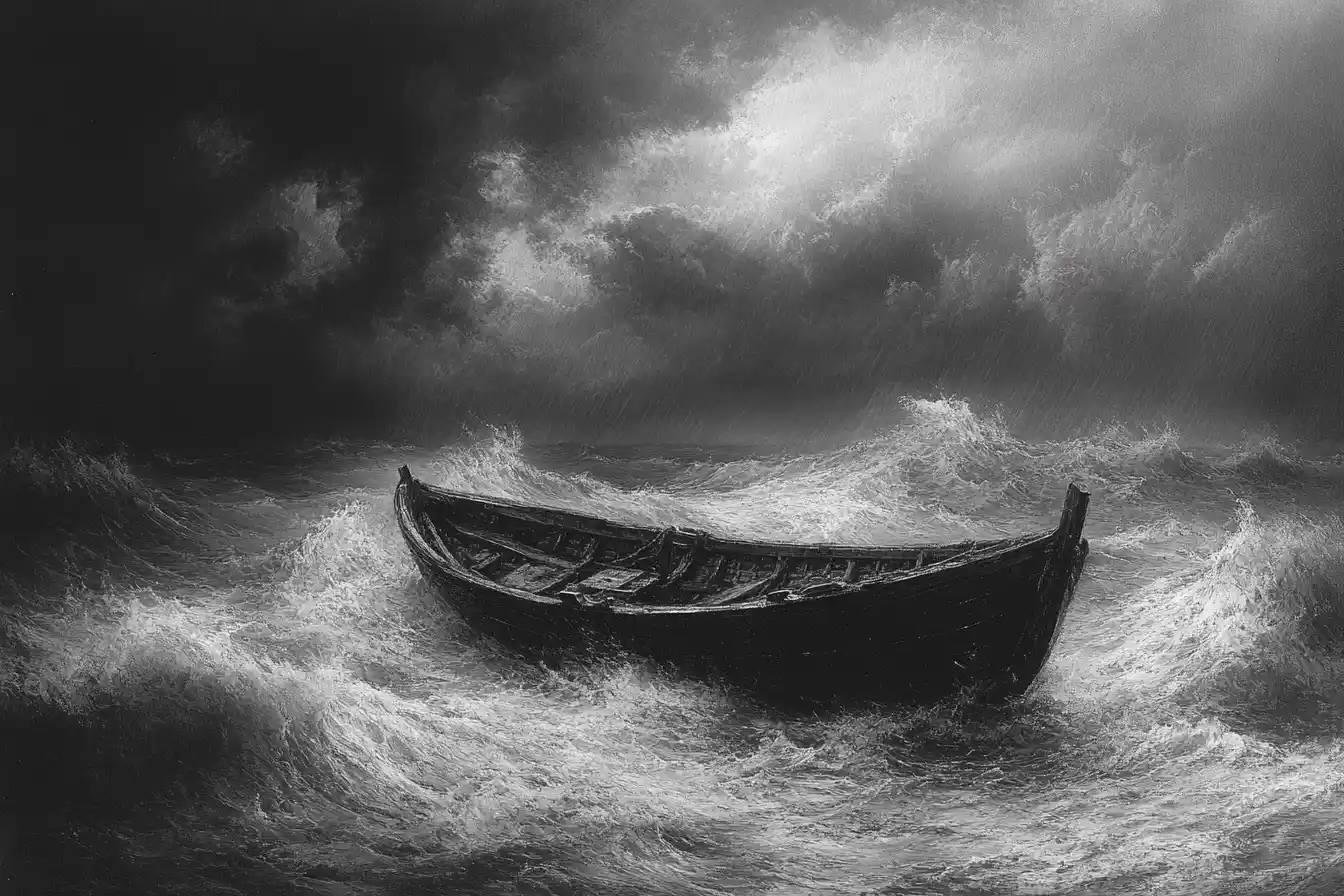
Recently, I heard myself telling a client that I am “like this” because I have been touched by death. And I realized that this expression describes, better than anything else, what matters most to me.
When I was seventeen, my mother died. But even before that happened, I lived constantly with the fear of death, because she had been ill for as long as I could remember. Whenever she had heart attacks, I was afraid she would die in front of my eyes.
My mother had been ill even before I was born. The doctors told her that with her heart condition it was not advisable to give birth, yet she decided to have a child. And so I was born in a hospital for mothers with heart disease. I can imagine how much fear I absorbed even while still in her womb—the fear that the birth of a new life might lead to the taking of another life.
The fear of death.
Now I think this was the greatest gift she left me—the encounter with death. Without it, I would not be who I am today: touched by death. Because people who have been touched by death are given the gift of seeing life differently—if, of course, they have managed to make friends with death.
And it is precisely this making friends with death that I want to speak about. In my experience, it is a long process of turning inward and asking the question of what does not die. It began about ten years after my mother’s death, when one question started to intrude persistently into my consciousness: “What is the meaning of life if one day I will die?”
If I imagine that everything which now stirs strong emotions, fears, and ambitions will one day disappear into the pit of death, then in that very moment it begins to look insignificant. I have struggled so hard to achieve it—only to lose it just like that.
And the same applied to everything—absolutely everything. My career, my relationships, my appearance, my possessions, my achievements. Whenever things did not turn out the way I wanted, I thought of death and suddenly it all became small. And sad. Everything lost its value; in everything I saw what could be taken away from me. And when I add to this the two car accidents I survived with nothing more than a wrecked car, the sense that death is not some abstraction waiting at the end of life, but something that breathes down my neck every day, every hour, every minute, became more and more vivid.
I can best describe this feeling with a metaphor. The metaphor of a person reaching out toward something—a person, an object, a career, a relationship… simply something from this material world. And the moment the hand comes close to it, it crumbles into ash. Even before the hand touches it, it disappears, and the hand grasps Nothingness. I was living in a world of shadows, in which everything disintegrated into dust before my eyes. At the very moment a desire arose for something, I could already see its end.
And this went on for years. The prevailing feeling was one of alienation from so-called normal life—a detachment that closely resembles depression. Back then I called it my endogenous depression. Now I know it was something else. But that is for another text. Here I want to speak about the touch of Death, because it gives much to those who allow themselves to make friends with it.
And this does not always begin with the death of a loved one. But it necessarily involves an experience of some kind of loss and ending—the loss of a relationship, goals, possessions, ideals, identities. A separation from what one values most. This is the archetype of the Destroyer in action. These are depressions, panic attacks, obsessive thoughts about illness and death, and the fear of losing control.
It is for precisely these people—those who have personally encountered the face of the Destroyer—that I share this. Because making friends with Death is nothing other than integrating the energy of this powerful archetype into our lives and growing through the lessons it brings. It is about freeing ourselves from our attachment to the things of the transient world. And in the space freed from them, seeing how a distance opens between you and this world. You stop taking things personally.
And so, the encounter with Death begins with fear—but ends with freedom. The greatest freedom possible.
Kameliya Hadzhiyska
Further reading: Osho, Death Is More Important Than Life